Grand Slam is the Showdown format with a ping-pong twist. After every third game the board offers a Lucky Bounce: one player from each team gets three bounces off the table into a cup, and the winner draws a power-up card. Cards change how a game is played, never what it pays, so a lucky bounce can’t buy a win. The team that’s behind still picks, and the comeback still kicks in.

Ping-pong party game show for 10–13 year olds Ping-pong balls everywhere. On purpose.
Grand Slam is a ping-pong game show that runs on your TV, for 8–10 kids aged 10–13. Ten quick games use ping-pong balls, cups and spoons, and you play for as long as the room wants. You need a TV and a browser. It costs $7.99.
No phones for the kids. No score sheet for you.
$7.99USD
Party Pass good for 30 days.
Get Grand SlamWatch a round ↓8–10 kids · Ages 10–13 · One TV
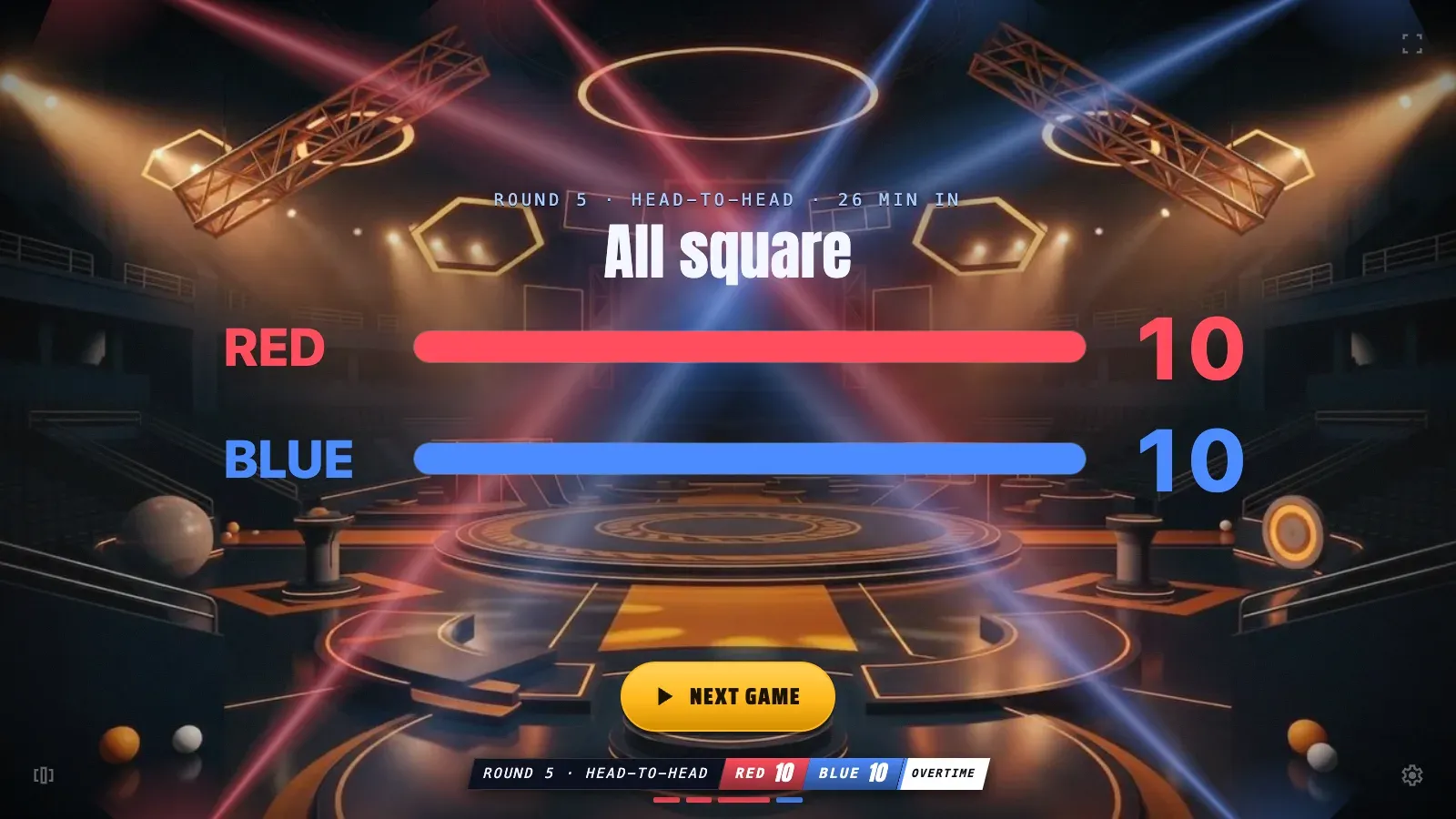
Blue wins a Lucky Bounce, draws a power-up, then turns a five-point hole into a 10–10 board. Watch the round →
Every third game, a Lucky Bounce.
Blue won the bounce, drew an Overtime card, then came back from 9–4 to 10–10.
You don’t plan a single game.
The TV carries every round, so you never have to remember rules, invent the next game or do maths mid-party. You read it out, keep it fair and call what happened.
No more “what do we play next?”
The team that’s behind picks from ten games on the board. The TV keeps a rhythm — two head-to-heads, then a team round — and suggests a card for a side that can’t decide.
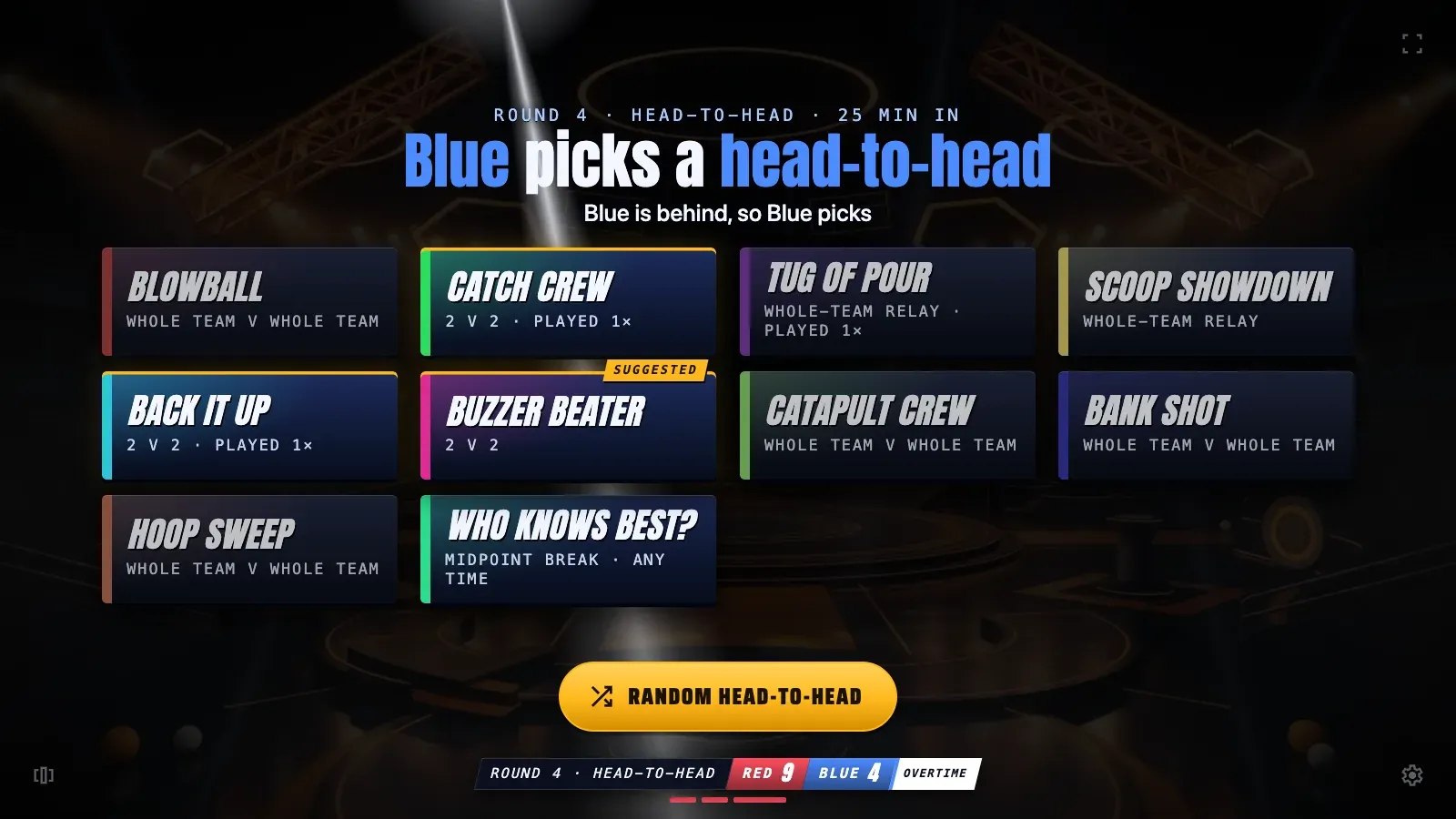
Every game gets an entrance.
The name slams onto the screen with what it takes to win, so everyone knows what’s coming before a single ball flies.

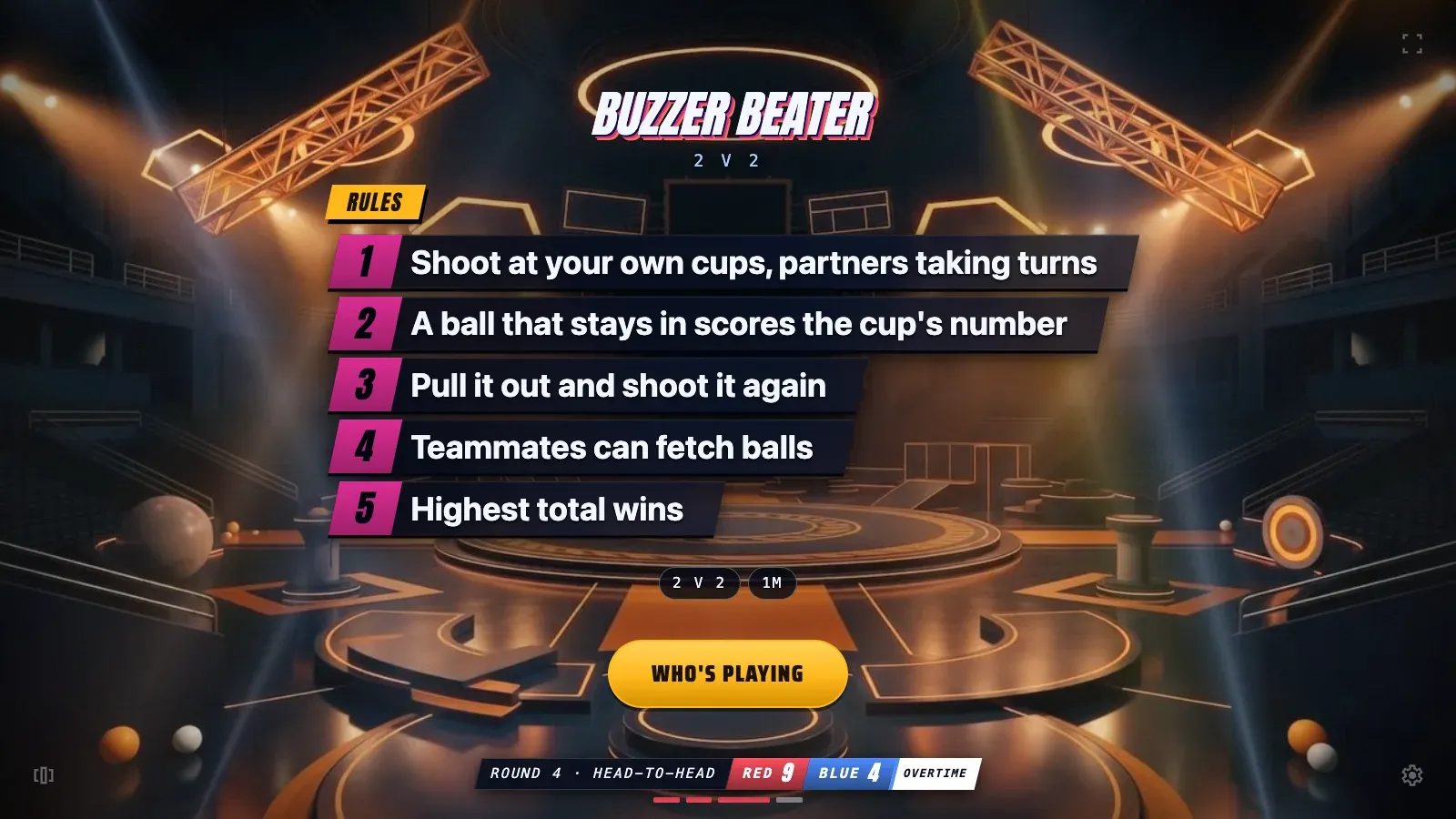
You don’t explain the rules.
What to grab and a tip for you, then the rules on a screen of their own, short enough to read out in one breath.
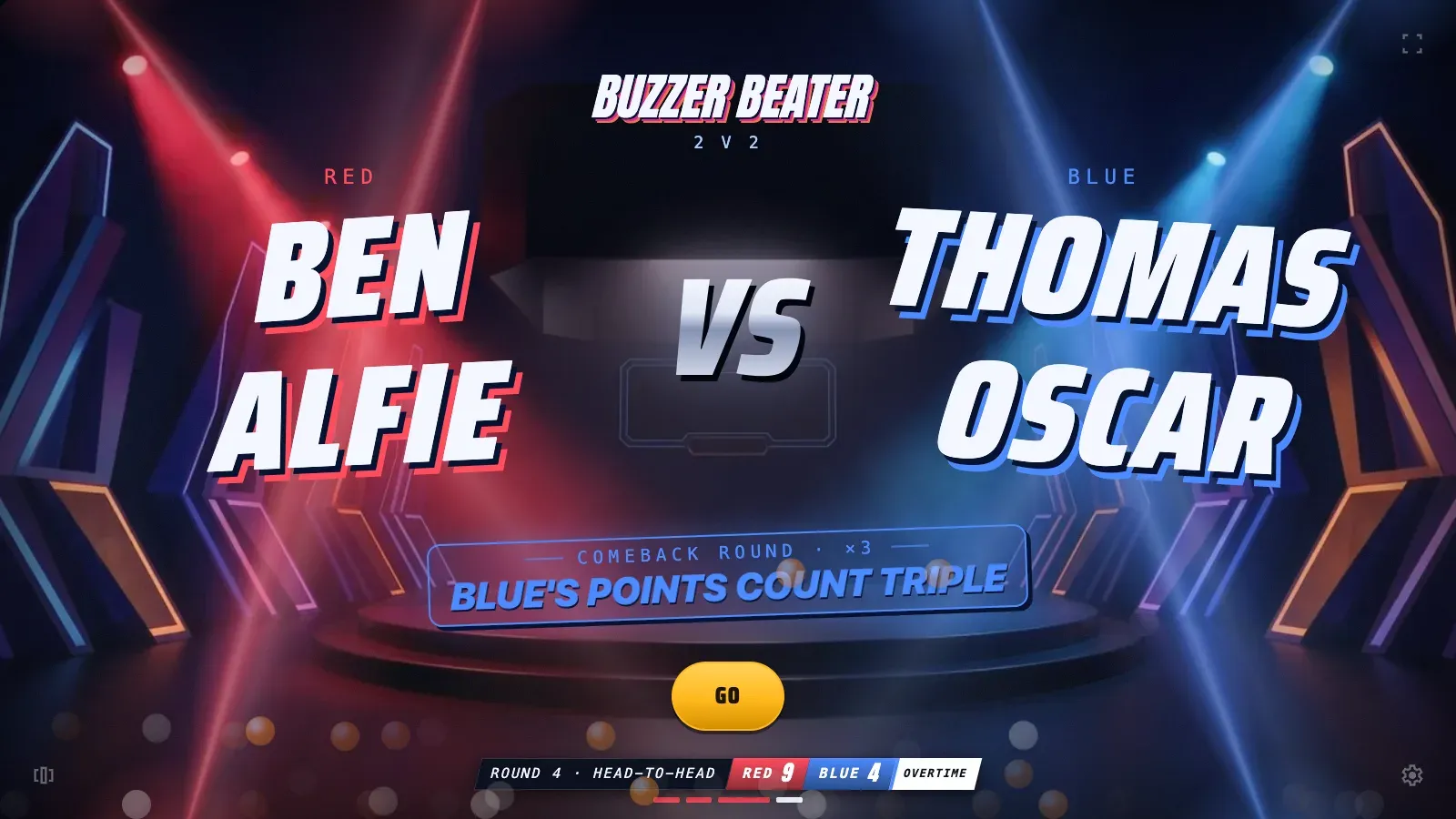
Everyone gets a turn.
The TV draws who’s up from each team, and nobody goes twice until everyone has gone once. A team 3 or more behind finds out here that its win counts ×2, ×3 or ×4.
The clock is the bad guy, not you.
A big 3 · 2 · 1, then the countdown is on the TV. You tap in every ball that lands; a team holding a power-up card can call it at the buzzer.
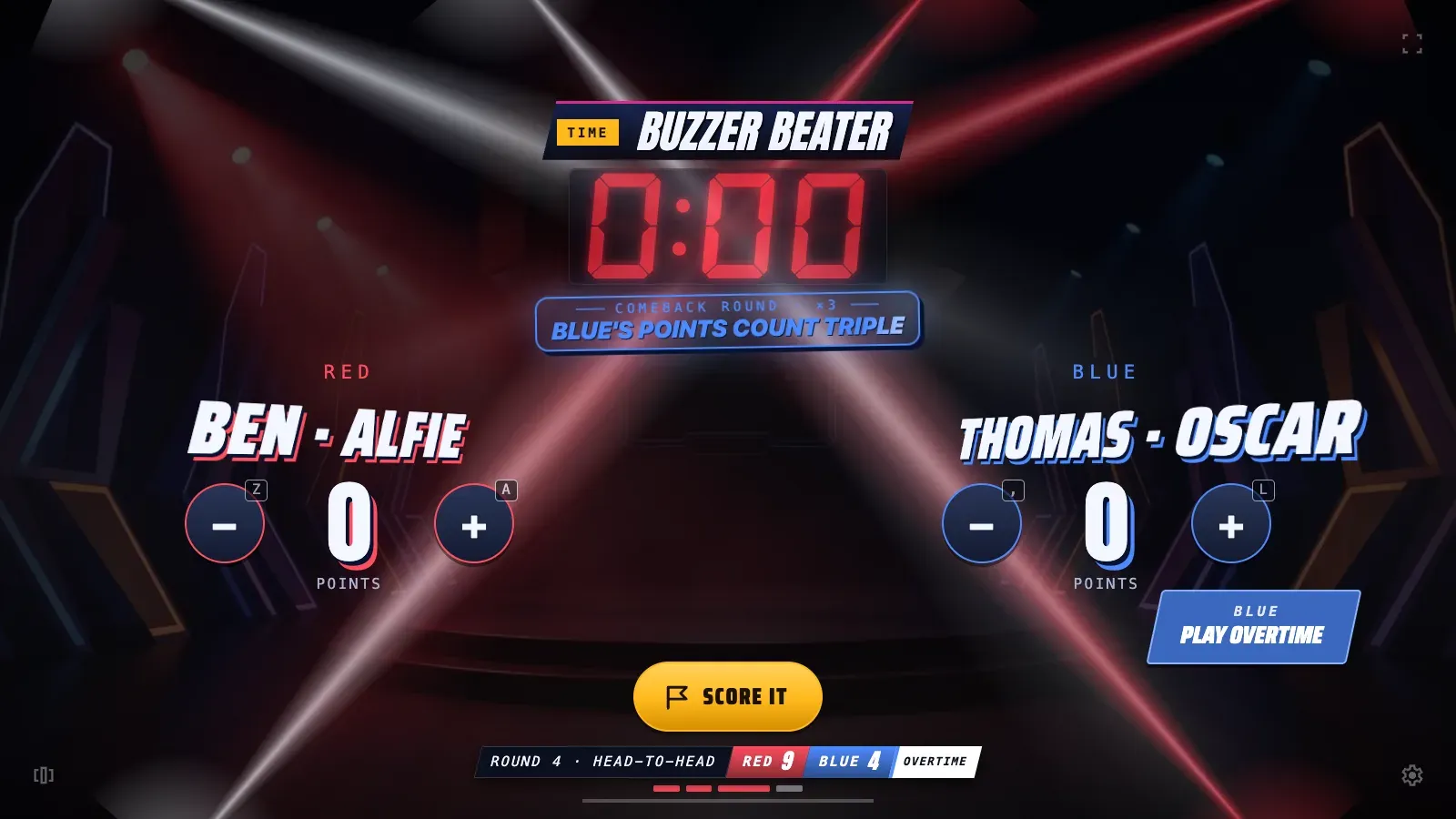
No score sheet on a napkin.
Points land on screen the moment you score it, comeback and all. It’s hard to argue with the TV.

There’s always one more round.
The bars climb and the totals count up. Every third game, a Lucky Bounce. Play for as long as the room wants; you decide when it’s the Finale.

Three cards. Zero points.
Each team can hold one card, and only one card can be played a game. A card bends how a game is played. It never touches the score.
- Substitute. Called on a two-on-two's matchup, before Go: swap one of your picked players for a teammate.
- Overtime. Called at the buzzer: both teams play on from where they are, for half the clock again.
- Extra Life. Called at the buzzer in Catch Crew, Back It Up, Buzzer Beater, Catapult Crew or Bank Shot: your side goes again from zero, and the better try counts.
Close until the last round.
Every round pays both teams something, and the team that’s behind always has a way back.
| Round | Win | Other side |
|---|---|---|
| Two-on-two | 2 | 1 |
| Team games and the birthday quiz | 5 | 2 |
| Any of the final three | 10 | as usual |
| Lucky Bounce | a card, no points | |
- A tie pays both sides the winner’s points.
- A team 3 or more behind when a round starts wins ×2, ×3 or ×4 — rolled by the TV, bigger the further behind, and kept quiet until the matchup.
- A loss pays as usual, so the leader only loses what they lose on the table.
Ten games. One bag of ping-pong balls.
Cups, bowls, spoons, paper plates and a hula hoop cover the rest. Every game shows what to grab before it starts, so you can set up as you go.
Blowball
Whole team v whole team · 90 sec
Blow the ball off the other team's end of the table.
Grab: a table, a ping-pong ball
Catch Crew
2 v 2 · 60 sec
One tosses, their partner catches in a cup.
Grab: ping-pong balls, a catching cup per pair, a goal bowl per pair
Tug of Pour
Whole-team relay · 90 sec
Spoon balls out of your bowl and into theirs.
Grab: 20 ping-pong balls, 2 bowls, 10 balls in each, a spoon per team
Scoop Showdown
Whole-team relay · 90 sec
Race balls from the shared bowl into yours.
Grab: a wide bowl of balls in the middle, a goal bowl per team, a spoon per team
Back It Up
2 v 2 · 60 sec
Toss it backwards over your shoulder; your partner catches in a cup.
Grab: ping-pong balls, a catching cup per pair, a goal bowl per pair
Buzzer Beater
2 v 2 · 60 sec
Sink balls in your cups marked 1, 2 and 3.
Grab: 3 cups per team, marked 1, 2 and 3, 2 balls per pair
Catapult Crew
Whole team v whole team · 90 sec
Flick balls off spoons; one teammate catches in a cup.
Grab: spoons, ping-pong balls, a catching cup per team, a goal bowl per team
Bank Shot
Whole team v whole team · 90 sec
Bounce balls off a teammate's plate; your catcher grabs the rebound.
Grab: ping-pong balls, a paper plate per team, a catching cup per team, a goal bowl per team
Hoop Sweep
Whole team v whole team · 60 sec
Fan the balls onto the other team's half of the hoop.
Grab: a hula hoop flat on a table, split into red and blue halves, ping-pong balls, the same number on each half, fans or paper plates
Who Knows Best?
Midpoint break · 8 min
Questions about the birthday kid. Then they reveal the answers.
Grab: a printed question sheet and a pen per player, the birthday kid's answer key
Their birthday. Your questions.
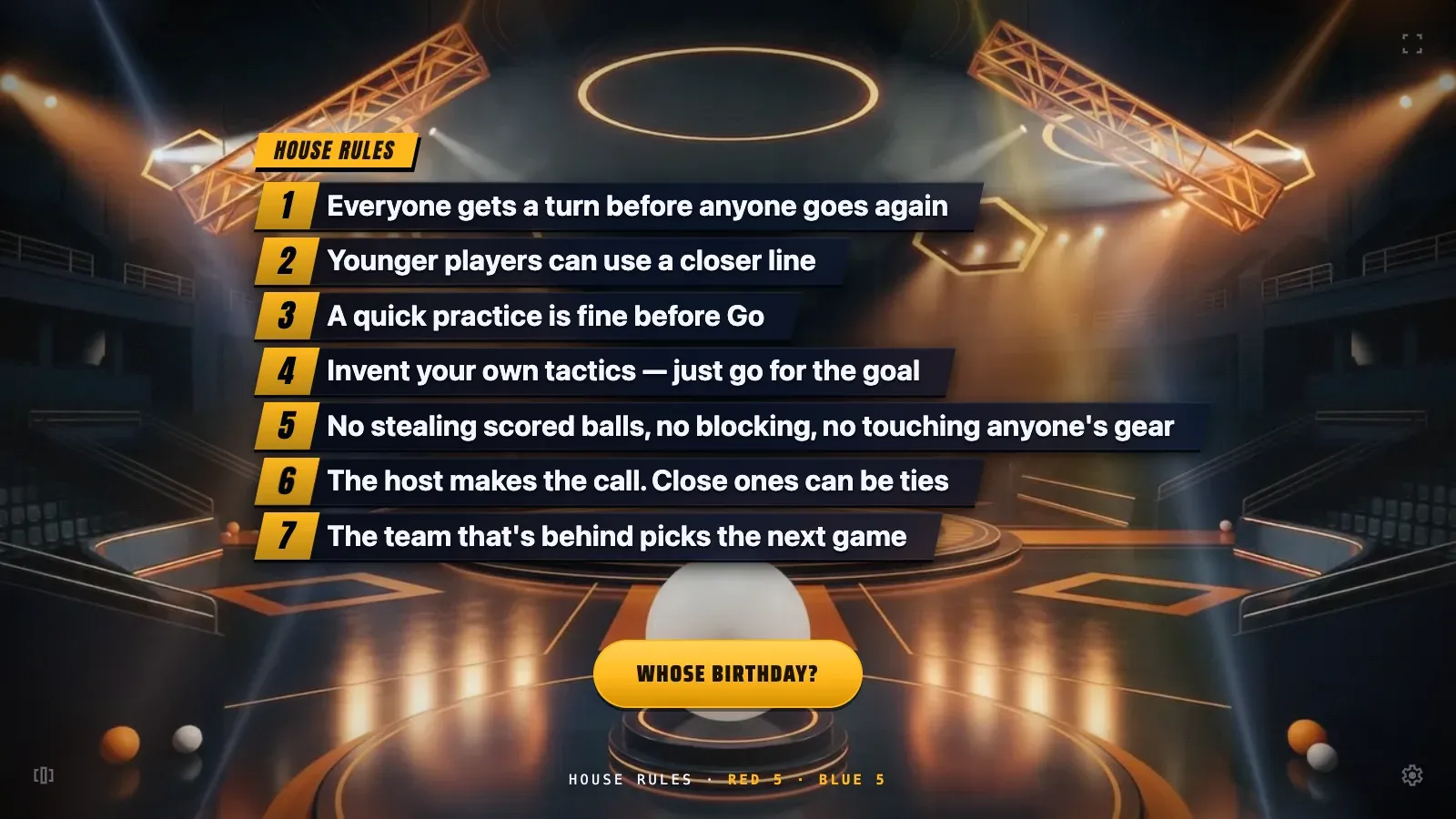
Before the first round the TV puts the house rules on screen for you to read out. Then you pick the birthday kid, and the quiz is yours to write: as many questions about them as you like.
- The app prints a sheet for every player
- And an answer key for you to read from
- Each answer stays hidden until you show it
You run the room, not the paperwork.
One button on the screen moves the party along. Undo takes back a wrong call, Pause holds the clock when the pizza arrives, and the Finale comes whenever you say so.
Get Grand SlamWho is it for?
A birthday party of 8 to 10 kids, about 10 to 13 years old, in two mixed-age teams.
What do we need?
A TV with a browser, or a laptop connected to one, a table, and a bag of ping-pong balls, plus cups, bowls, spoons, paper plates and a hula hoop. Every game shows what to grab before it starts.
Ready for Grand Slam?
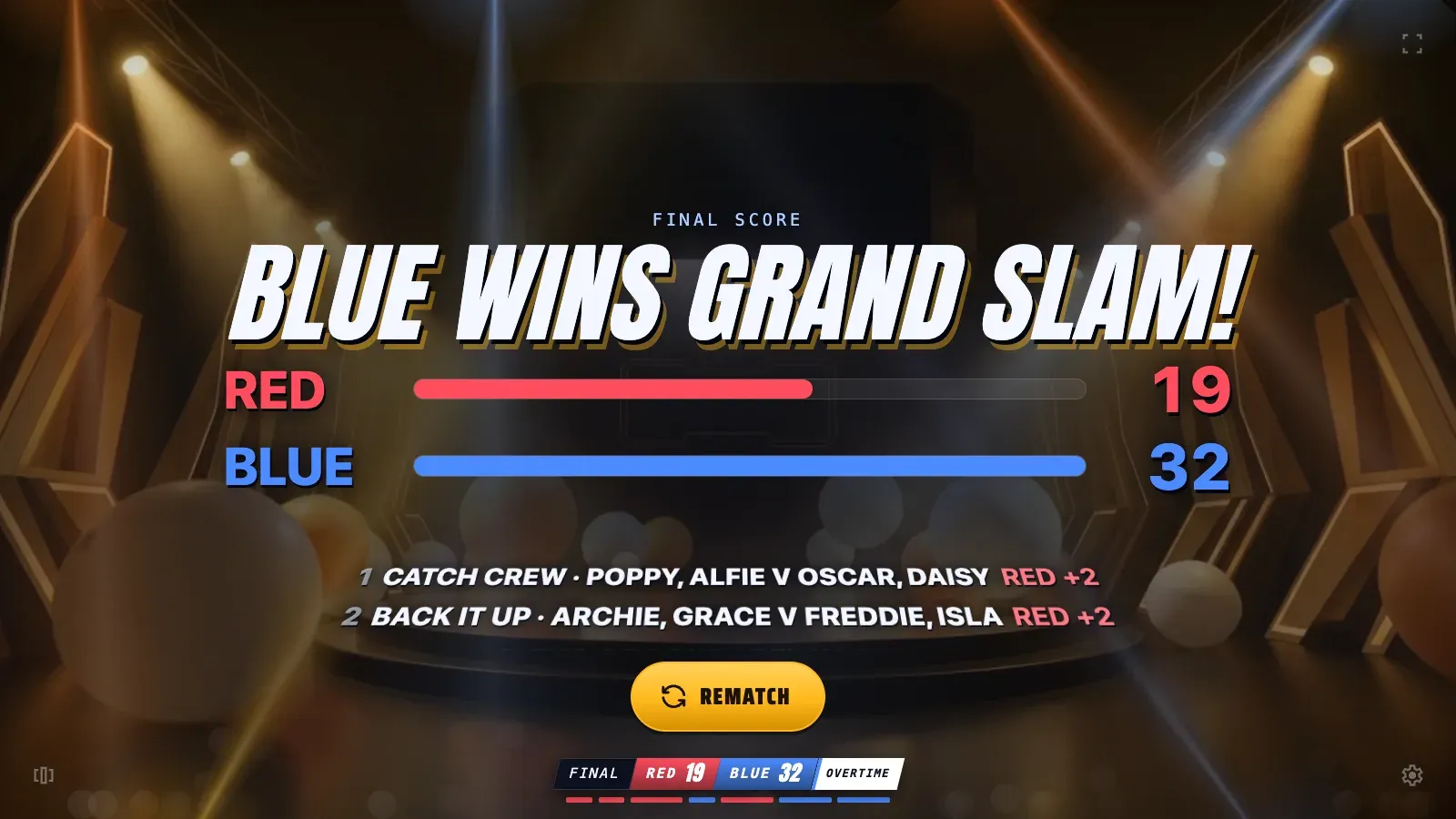
The bars grow under a drum roll, the winning team lands on screen, and every game rolls past. Then somebody asks for a rematch.
$7.99USD
Party Pass good for 30 days.
Get Grand SlamCookies and paper planes too? Showdown is the same show with twelve games of every kind.
Print these before the party.
A setup sheet to shop from and the rules for every game in one place. The quiz sheet has fifteen starter questions; write your own and the app prints a sheet for them.
Guides
Free to read before you run Grand Slam, whether or not you buy it.
- 10 ping pong ball party games for kidsWhat to grab, the rules, a running order, and scoring that keeps both teams trying.
- Free printable ping-pong party gamesSetup, rules and the birthday quiz as PDFs, with every game written out.
- Grand Slam FAQWhat you need, whether kids need phones, and what arrives when you buy.
- Every guide
Before the first serve.
How is it different from Showdown?
Same show, same scoring and the same comeback. Every game but the birthday quiz uses ping-pong balls, and every third game a Lucky Bounce wins a team a power-up card. The birthday quiz uses questions you write yourself.
How many games are there?
Ten: three two-on-twos, two team relays, four whole-team games and a birthday quiz.
What if one team gets way ahead?
A team behind by 3 or more when a round starts plays a comeback round: anything it wins pays double, triple or quadruple, and nobody knows until the matchup. It switches off once the gap closes.
Does everyone get a turn?
Yes. Each team works through its own shuffled order, and nobody goes twice until everybody on their team has played. If one team is bigger in a relay, its extras sit that one out and go first next round. Whole-team games include everybody.
What if people arrive late or leave early?
Add, remove or move players whenever the clock isn't running and no Lucky Bounce is on the floor. The score stays with the team, and anyone who joins a team goes first on it.
How do I keep it fair with mixed ages?
Put older and younger kids on both teams. The TV's tips help for each game, like setting a distance everyone can make, letting each pair pick its own, and assigning spots so bigger kids don't crowd the others.
Do the kids need phones?
No. The TV runs the show and the host runs the TV. Players need no phones, controllers or app.
What arrives when I buy?
A code by email that opens Grand Slam on your TV for 30 days from purchase. Play it as often as you like in that window.